

Obesity-Related Dyslipidemia in Domestic Cats: A Comparative Analysis of Lipid Profile Alterations
DOI:
https://doi.org/10.5380/avs.v30i4.101477Palavras-chave:
triglycerides; body condition score; overweight; HDL cholesterol.Resumo
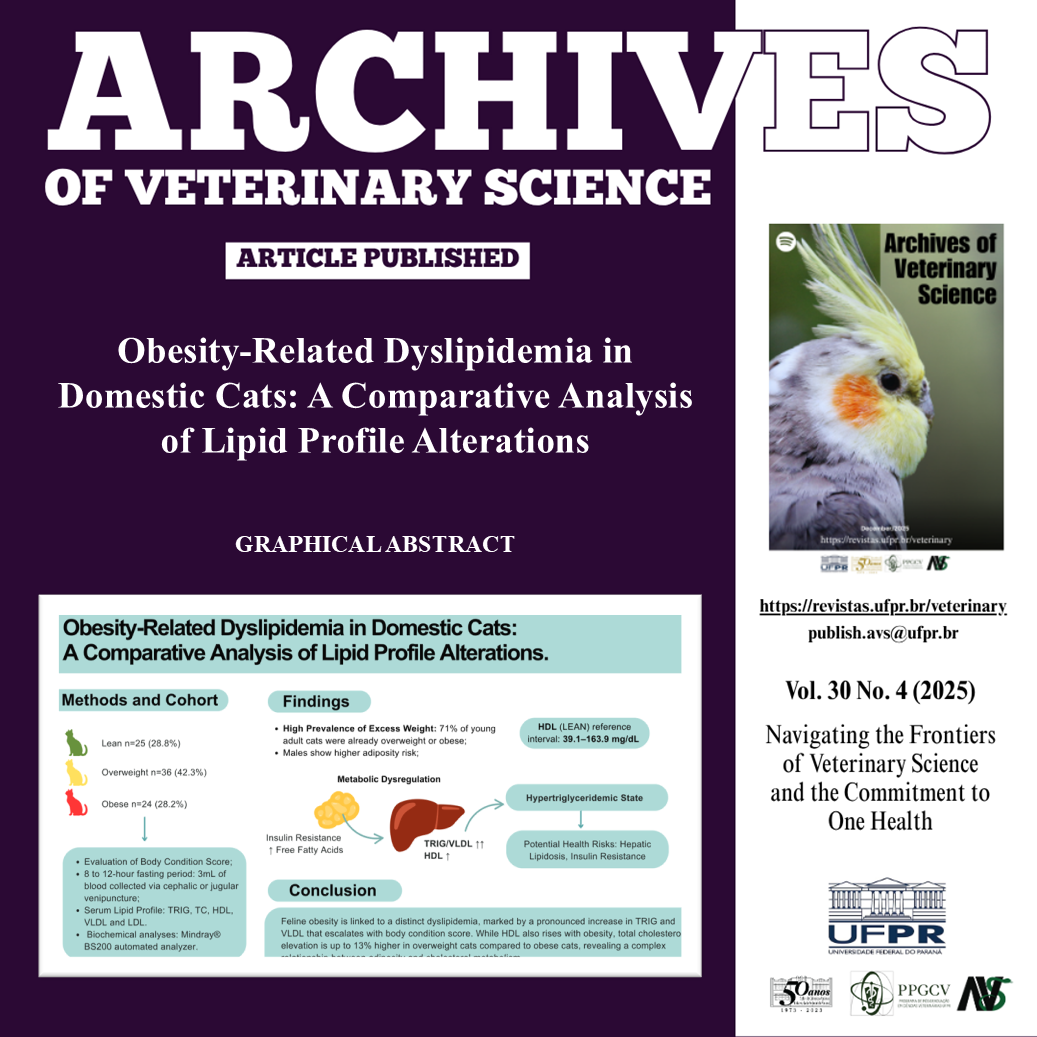
Feline obesity is a prevalent disorder that predisposes cats to metabolic diseases, but comprehensive data on its specific effects on serum lipid profiles are lacking. This study aimed to establish reference intervals for HDL cholesterol and a lipid profile in healthy lean cats; characterized serum concentrations of total cholesterol, HDL, VLDL, LDL, and triglycerides, and to characterize alterations across body condition scores, age groups, and between sexes. In a prospective cross-sectional study of eighty-five client-owned cats (25 lean, 60 overweight/obese), body condition was assessed using body weight and a 9-point BCS system. Biochemical analyses were performed using a Mindray® BS200 automated analyzer. Results established an HDL reference interval of 39.1–163.9 mg/dL for lean cats. Obesity was linked to a distinct dyslipidemia, characterized by a pronounced 58% increase in triglycerides and rising VLDL. Interestingly, while HDL increased with obesity, total cholesterol was up to 13% higher in overweight versus obese cats, indicating a complex metabolic relationship. A significant finding was that 71.2% of young adult cats were already above ideal BCS, with the highest obesity rate (40%) in mature adults. A notable sex disparity was observed, with male cats showing a greater tendency toward higher adiposity.
Referências
Mori, N., Takemitsu, H., Ohta, H., Kato, Y., Sako, T., Kurosawa, T., Tsujimoto, H., Iwasaki, E., Kato, M., Kido, T., et al. Overall prevalence of feline overweight/obesity in Japan as determined from a cross-sectional sample pool of healthy veterinary clinic-visiting cats in Japan. Turk. J. Vet. Anim. Sci., v. 40, n. 3, p. 304–312, 2016. https://doi.org/10.3906/vet-1502-31
Blanchard, T., Rouch, B., Roux, T., Biourge, V., Pilot-Storck, F., German, A.J. Prevalence and factors associated with overweight and obesity in cats in veterinary hospitals in France during the COVID-19 pandemic. J. Feline Med. Surg., v. 27, n. 2, p. 1-9, 2025. https://doi.org/10.1177/1098612X241305924.
Montoya, M., Morrison, J.A., McCann, C., Roux, T., Biourge, V., German, A.J. Overweight and obese body condition in ~4.9 million dogs and ~1.3 million cats seen at primary practices across the USA: Prevalences by life stage from early growth to senior. Prev. Vet. Med., v. 235, p. 1-10, 2025. https://doi.org/10.1016/j.prevetmed.2024.106398.
Mori, N., Lee, P., Kondo, K., Kido, T., Sako, T., Arai, T. Preliminary analysis of modified low-density lipoproteins in the serum of healthy and obese dogs and cats. Front. Vet. Sci., v. 2, n. 34, p. 1-7, 2015. https://doi.org/10.3389/fvets.2015.00034.
Xenoulis, P.G., Steiner, J.M. Lipid metabolism and hyperlipidemia in dogs. Vet. J., v. 183, p. 12–21, 2010. https://doi.org/10.1016/j.tvjl.2008.10.011.
Valtolina, C., Favier, R.P. Feline hepatic lipidosis. Vet. Clin. Small Anim. Pract., v. 47, p. 683–702, 2017. https://doi.org/10.1016/j.cvsm.2016.11.014.
Pazak, H.E., Bartges, J.W., Cornelius, L.C., Scott, M.A., Gross, K., Huber, T.L. Characterization of serum lipoprotein profiles of healthy, adult cats and idiopathic feline hepatic lipidosis patients. J. Nutr., v. 128, p. 2747S–2750S, 1998. https://doi.org/10.1093/jn/128.12.2747S.
Bauer, J.E. Comparative lipid and lipoprotein metabolism. Vet. Clin. Pathol., v. 25, p. 49–56, 1996. https://doi.org/10.1111/j.1939-165X.1996.tb00968.x.
Jordan, E., Kley, S., Le, N.A., Waldron, M., Hoenig, M. Dyslipidemia in obese cats. Domest. Anim. Endocrinol., v. 35, p. 290–299, 2008. https://doi.org/10.1016/j.domaniend.2008.05.008.
Vekic, J., Stefanovic, A., Zeljkovic, A. Obesity and dyslipidemia: a review of current evidence. Curr. Obes. Rep., v. 12, p. 207–222, 2023. https://doi.org/10.1007/s13679-023-00518-z.
Liu, J., Sempos, C., Donahue, R.P., Dorn, J., Trevisan, M., Grundy, S.M. Non–high–density lipoprotein and very-low-density lipoprotein cholesterol and their risk predictive values in coronary heart disease. Am. J. Cardiol., v. 98, p. 1363–1368, 2006. https://doi.org/10.1016/j.amjcard.2006.06.032.
Choi, K. A Pilot Study of the Total Cholesterol/High-Density Lipoprotein Ratio as a Prognostic Indicator of Hyperlipidemia-Related Diseases in Dogs and Cats. Curr. Issues Mol. Biol., v. 46, p. 12174–12182, 2024. https://doi.org/10.3390/cimb46110722.
Hoenig, M. The cat as a model for human obesity and diabetes. J. Diabetes Sci. Technol., v. 6, p. 525–533, 2012. https://doi.org/10.1177/193229681200600306.
Laflamme, D.P. Development and validation of a body condition score system for dogs. Canine Pract., v. 22, p. 10–15, 1997.
Teng, K.T., McGreevy, P.D., Toribio, J.L.M.L., Dhand, N.K. Strong associations of nine-point body condition scoring with survival and lifespan in cats. J. Feline Med. Surg. 20, p. 1110–1118, 2018. https://doi.org/10.1177/1098612X17752198.
Quimby, J., Gowland, S., Carney, H.C., DePorter, T., Plummer, P., Westropp, J. 2021 AAHA/AAFP feline life stage guidelines. J. Feline Med. Surg., v. 23, p. 211–233, 2021. https://doi.org/10.1177/1098612X21993657.
Rodan, I., Sundahl, E., Carney, H., Gagnon, A.C., Heath, S., Landsberg, G., Seksel, K., Yin, S. AAFP and ISFM fe-line-friendly handling guidelines. J. Feline Med. Surg., v. 13, p. 364–375, 2011. https://doi.org/10.1016/j.jfms.2011.03.012.
Friedewald, W.T., Levy, R.I., Fredrickson, D.S. Estimation of the concentration of low-density lipoprotein cholesterol in plasma, without use of the preparative ultracentrifuge. Clin. Chem., v. 18, p. 499–502, 1972.
Muranaka, S., Mori, N., Koyama, H., Ohta, H., Sako, T., Arai, T., Mori, B. Obesity induced changes to plasma adiponectin concentration and cholesterol lipoprotein composition profile in cats. Res. Vet. Sci., v. 91, p. 358–361, 2011. https://doi.org/10.1016/j.rvsc.2010.09.012.
Courcier, E.A., O’Higgins, R., Mellor, D.J., Yam, P.S. An investigation into the epidemiology of feline obesity in Great Britain: results of a cross-sectional study of 47 companion animal practices. Vet. Rec., v. 171, p. 560, 2012. https://doi.org/10.1136/vr.100953.
Russell, K., Sabin, R., Holt, S., Bradley, R., Harper, E.J. Influence of feeding regimen on body condition in the cat. J. Small Anim. Pract., v. 41, p. 12–17, 2000. https://doi.org/10.1111/j.1748-5827.2000.tb03129.x.
Bjornvad, C.R., Nielsen, D.H., Armstrong, P.J., McEvoy, F., Hoelmkjaer, K.M., Jensen, K.S., Pedersen, G.F., Kristensen, A.T. Obesity and sex influence insulin resistance and total and multimer adiponectin levels in adult neutered domestic shorthair client-owned cats. Domest. Anim. Endocrinol., v. 47, p. 55–64, 2014. https://doi.org/10.1016/j.domaniend.2013.12.005.
Merenda, M.E.Z., Grant, C.K., Vester Boler, B.M., Shoveller, A.K. Growth curve and energy intake in male and female cats. Top. Companion Anim. Med., v. 44, p. 100518, 2021. https://doi.org/10.1016/j.tcam.2021.100518.
Larsen, J.A. Risk of obesity in the neutered cat. J. Feline Med. Surg. v. 19, p. 779–783, 2017. https://doi.org/10.1177/1098612X17706475.
Phungviwatnikul, T., Valentine, H., de Godoy, M.R.C., Swanson, K.S. Effects of diet on body weight, body composition, metabolic status, and physical activity levels of adult female dogs after spay surgery. J. Anim. Sci., v. 98, n. 3, p. 1-63, 2020. https://doi.org/10.1093/jas/skaa057.
Bjørnvad, C.R., Gloor, S., Johansen, S.S., Sandøe, P., Lund, T.B. Neutering increases the risk of obesity in male dogs but not in bitches—A cross-sectional study of dog-and owner-related risk factors for obesity in Danish companion dogs. Prev. Vet. Med., v. 170, p. 104730, 2019. https://doi.org/10.1016/j.prevetmed.2019.104730.
Song, R., Peng, W., Zhang, Y., Lv, F., Wu, H.K., Guo, J., Cao, Y., Pi, Y., Zhang, X., Sun, L., et al. The roles of lipid metabolism in the pathogenesis of chronic diseases in the elderly. Nutrients, v. 15, p. 3433, 2023. https://doi.org/10.3390/nu15153433.
Chala, I.V., Lytvynenko, O.V., Panteleienko, O.V., Kutsan, A.T. Changes in the lipid profile of neutered cats’ blood in cases of obesity and diabetes. Vet. Arh., v. 91, p. 635–645, 2021. DOI: 10.24099/vet.arhiv.1087.
Karkamo, V., Hytönen, M.K., Arumilli, M., Lilliebücke, E., Junnila, J., Sainio, A., Pessa-Morikawa, T., Iivanainen, A., Lohi, H. Heterozygous Korat cats with LDL receptor mutation are asymptomatic and normolipidemic. Res. Vet. Sci., v. 180, p. 105784, 2025. https://doi.org/10.1016/j.rvsc.2025.105784.
Lee, J., Lee, J.Y., Lee, J.H., Park, J.B. Validation of the Friedewald formula for estimating low-density lipoprotein cholesterol: the Korea National Health and Nutrition Examination Survey, 2009 to 2011. Korean J. Intern. Med., v. 35, p. 150–158, 2018. Doi: 10.3904/kjim.2017.233.
Publicado
Como Citar
Edição
Seção
Licença

Este trabalho está licenciado sob uma licença Creative Commons Attribution-ShareAlike 4.0 International License.
Autores que publicam nesta revista concordam com os seguintes termos:
- Autores mantém os direitos autorais e concedem à revista o direito de primeira publicação, com o trabalho simultaneamente licenciado sob a Creative Commons - Atribuição 4.0 Internacional que permite o compartilhamento do trabalho com reconhecimento da autoria e publicação inicial nesta revista.
- Autores têm autorização para assumir contratos adicionais separadamente, para distribuição não-exclusiva da versão do trabalho publicada nesta revista (ex.: publicar em repositório institucional ou como capítulo de livro), com reconhecimento de autoria e publicação inicial nesta revista.
- Autores têm permissão e são estimulados a publicar e distribuir seu trabalho online (ex.: em repositórios institucionais ou na sua página pessoal) a qualquer ponto antes ou durante o processo editorial, já que isso pode gerar alterações produtivas, bem como aumentar o impacto e a citação do trabalho publicado.