
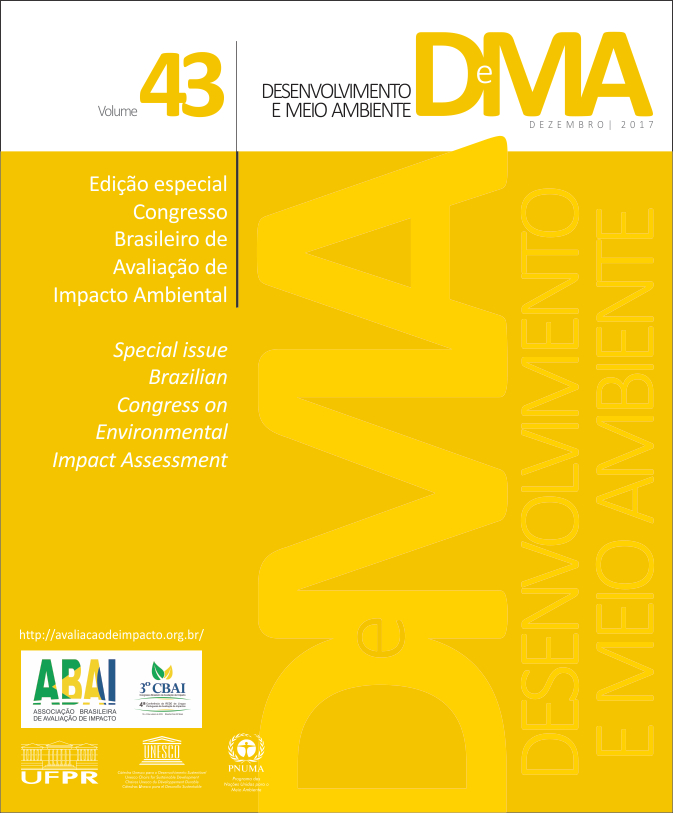
Public Participation in the Environmental Impact Assessment Process in the State of Espírito Santo
DOI:
https://doi.org/10.5380/dma.v43i0.54188Keywords:
public participation, environmental impact assessment, environmental impact statement, environmental licensingAbstract
Under the assertions of making the EIA process more agile and less bureaucratic, some countries have taken opposing measures to democratize environmental management by reducing public involvement by adopting controversial changes such as eliminating the public participation of special classes of projects. The importance attached to public participation in practice is echoed in the scientific literature not only as a principle in itself, but there seems to be a general consensus that public participation is also central to an effective environmental assessment. This article aims to identify the forms of public participation in the EIA process of projects in the State of Espirito Santo. In order to do so, the documentary research methodology was adopted within the framework of the State Environmental Institute, in the environmental licensing processes of projects that presented an Environmental Impact Study. Decree No. 1,777-R, which provides for the System for the Licensing and Control of Pollution and Environmental Degradation Activities / SILCAP, which is currently the main instrument used by the state environmental activities related to environmental licensing. The survey included all the physical and digital documents available for public participation in 44 environmental licensing processes between January 2007 and May 2016.
Downloads
Published
How to Cite
Issue
Section
License
Copyright on works published in this journal rests with the author, with first publication rights for the journal. The content of published works is the sole responsibility of the authors. DMA is an open access journal and has adopted the Creative Commons Attribution 4.0 Not Adapted (CC-BY) license since January 2023. Therefore, when published by this journal, articles are free to share (copy and redistribute the material in any medium or format for any purpose, even commercial) and adapt (remix, transform, and create from the material for any purpose, even commercial). You must give appropriate credit, provide a link to the license and indicate if changes have been made.
The contents published by DMA from v. 53, 2020 to v. 60, 2022 are protected by the Creative Commons Attribution-NonCommercial-NoDerivatives 4.0 International license.
DMA has been an open access journal since its creation, however, from v.1 of 2000 to v. 52 of 2019, the journal did not adopt a Creative Commons license and therefore the type of license is not indicated on the first page of the articles.


.png)