

Português Português
English
DOI:
https://doi.org/10.5380/abp.v54i1.100708Abstract
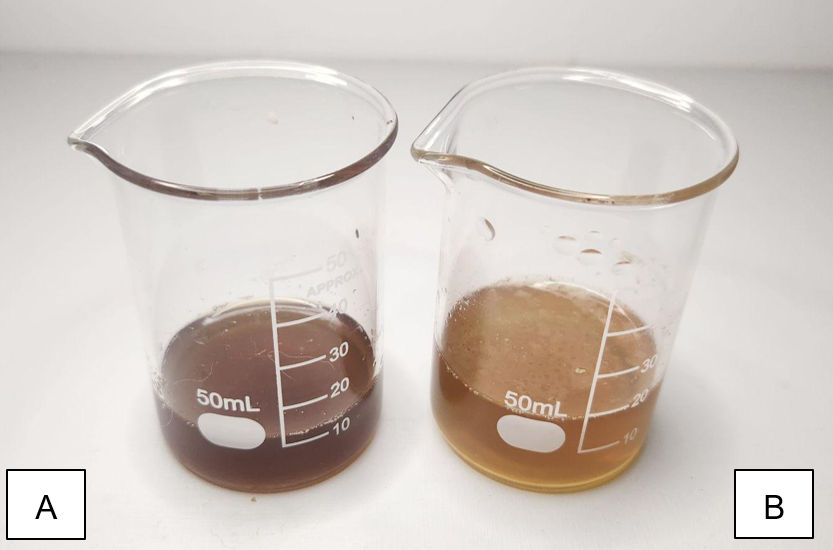
The present study analyzed the labeling and adulteration of Apis mellifera honeys sold in municipalities on the North Coast of São Paulo State, Brazil, using the Lugol test and moisture content. Twenty honey samples were purchased from different establishments and assessed for compliance with current Brazilian law. The results indicated that 30% of the samples had labeling non-conformities, with the main deficiencies being the absence of nutritional information, identification of the establishment of origin or a complete lack of labeling, and absence labeling requirements, such as inspection of products of animal origin. Additionally, one case of falsified inspection registration was identified. Regarding quality, 15% of the samples had a moisture content above the legal limit. In the Lugol test, 25% of the samples showed a positive reaction, suggesting the addition of undeclared syrups or sugars. The findings highlight the need for increased monitoring and control of honey commercialization in the region to ensure food safety and consumer transparency.
Downloads
Published
How to Cite
Issue
Section
License
Copyright (c) 2025 Gabriel França Nagamatsu, Denise de Lima Belisario, Guilherme Santos Monteiro, Lídia Maria Ruv Carelli

This work is licensed under a Creative Commons Attribution 4.0 International License.
The authors have permission and are encouraged to deposit their papers in personal web pages, institutional repositories or portals before (pre-print) or after (post-print) the publication at Acta Biológica Paranaense. It is just asked, when and where possible, the mention, as a bibliographic reference (including the atributted URL), to the Journal.
The authors license the Acta Biológica Paranaense for the solely purpose of disseminate the published work (peer reviewed version/post-print) in aggregation, curation and indexing systems.

The papers copyrights belong to the authors/respondents. All the journal content (including instructions, editorial policies and templates) - except where otherwise indicated - is under a Creative Commons Attribution 4.0 International, since October 2021.
Once published by Acta Biológica Paranaense, the papers are open access for scholarly and research use. The indication of the original source is mandatory.
Acta Biológica Paranaense does not apply any charges regarding manuscripts submission/processing and papers publication.