

Use of Spiny-legged Stingless Bee Trigona spinipes (Fabricius, 1793) as a Food Resource by the Yellow-chevroned Parakeet Brotogeris chiriri (Vieillot, 1818) in Southeastern Brazil
DOI:
https://doi.org/10.5380/abp.v54i1.100263Abstract
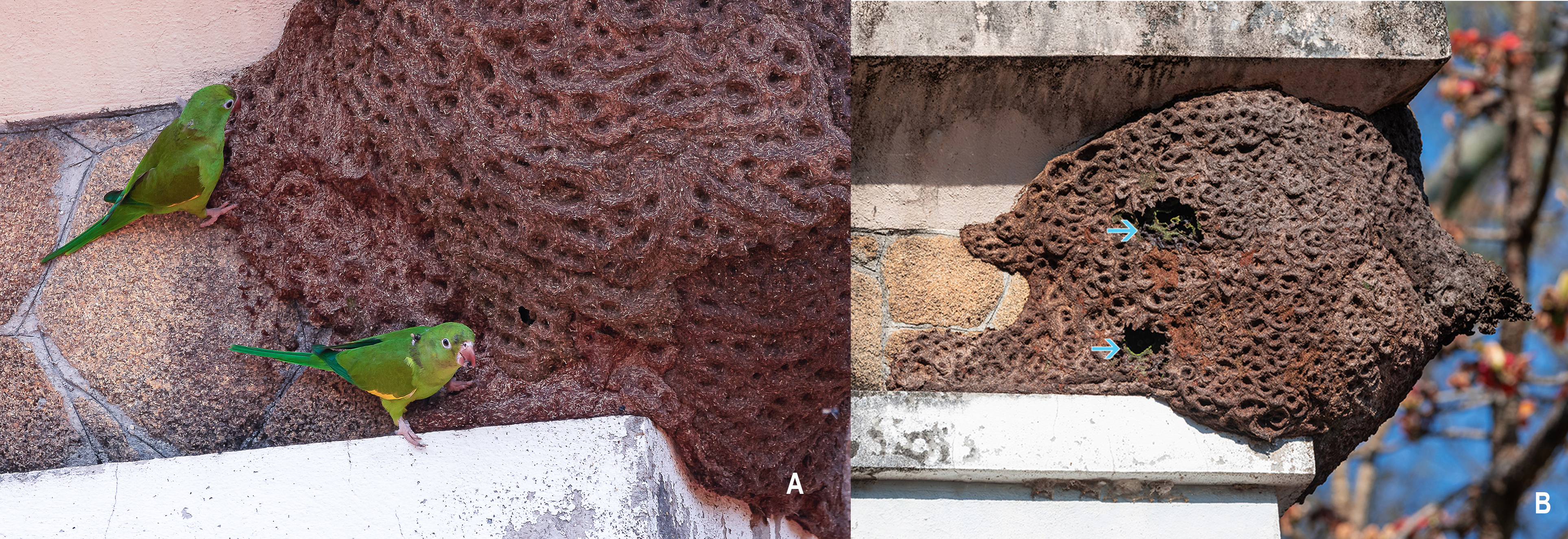
In this study, I report the first record of the use of Trigona spinipes stingless bees as a food resource by the Yellow-chevroned Parakeet (Brotogeris chiriri) in a forested area in the municipality of Atibaia, São Paulo. The study was conducted between 2022 and 2025, totaling 2 hours and 35 minutes of observation. The parakeets were observed interacting with the bees mainly in the morning, when nest activity was reduced and the bees were less aggressive. The consumption of bees may represent an alternative source of nutrients, especially proteins and carbohydrates, during periods of fruit and seed scarcity.
Keywords: Psittacines, feeding behavior, social bees, diet.
Downloads
Published
How to Cite
Issue
Section
License
Copyright (c) 2025 William Zaca

This work is licensed under a Creative Commons Attribution 4.0 International License.
The authors have permission and are encouraged to deposit their papers in personal web pages, institutional repositories or portals before (pre-print) or after (post-print) the publication at Acta Biológica Paranaense. It is just asked, when and where possible, the mention, as a bibliographic reference (including the atributted URL), to the Journal.
The authors license the Acta Biológica Paranaense for the solely purpose of disseminate the published work (peer reviewed version/post-print) in aggregation, curation and indexing systems.

The papers copyrights belong to the authors/respondents. All the journal content (including instructions, editorial policies and templates) - except where otherwise indicated - is under a Creative Commons Attribution 4.0 International, since October 2021.
Once published by Acta Biológica Paranaense, the papers are open access for scholarly and research use. The indication of the original source is mandatory.
Acta Biológica Paranaense does not apply any charges regarding manuscripts submission/processing and papers publication.